Before the House Manual: How Household Knowledge Was Kept
Before the house manual, household knowledge travelled by voice, handwritten notes and print. See how each method passed practical know-how between people.
A child reaches for a stained cloth as a relative sorts the washing and says, “Not with the coloured things.” Household knowledge is often passed on in moments like this: beside the task, with room for a question and a demonstration. A note pinned near the laundry or a printed reference can carry advice beyond the room where it was first learned.
These forms can work together. Conversation, handwritten records and printed references each preserve different kinds of domestic knowledge, and each suits a different relationship between the person who knows and the person learning. Rather than assuming one form replaced another, it is more useful to consider what each can convey.
Oral teaching keeps instruction close to the task
A person can show someone else how to knead dough, mend a seam, polish furniture or recognise when a room needs airing. The learner can ask questions as the work proceeds, while the teacher can demonstrate again or point out a detail that words alone might miss.
Demonstration can convey judgement as well as a sequence of actions: how damp a cloth should feel, what sound to listen for, or when a repair needs a more experienced hand. Such details depend on materials, tools and circumstances, so a spoken lesson can be adjusted to the task in front of both people.
Its limits are just as practical. A lesson may not be available when the learner needs it, and a technique can be difficult to recall after a long interval. Oral teaching is a useful way to pass on skills that benefit from observation, but recurring instructions may need a written reminder as well.
Handwritten records preserve local detail
A family notebook, a recipe card, a mending list or a note kept beside an item can record details that apply to one home. A recipe might include a household’s preferred adjustment; a note might identify the drawer holding spare buttons or the cloth kept for a particular surface.
Handwritten records can be revised as circumstances change. Crossings-out and additions make room for a lesson learned through use, although a note can become difficult to interpret if it relies on private shorthand. “Usual rinse” may tell its author enough and leave a new reader guessing.
When writing for someone else, name the object or task, give the relevant context and explain any exception. Handwritten notes are especially useful for local knowledge that a general reference would not know, provided another person can understand them without the author present.
Printed references provide a shared starting point
A printed household reference can gather guidance on cooking, cleaning, sewing or caring for belongings in one place. It lets a reader consult a general account without first finding someone who already knows the subject.
Print can also make advice seem more authoritative than it is. A book addresses an imagined reader and may assume particular tools, materials or circumstances. Readers still need to decide whether the guidance applies to their own home and the item in front of them.
Printed references are useful for broad techniques, unfamiliar terms and an initial account of a subject. They are less suited to teaching the feel of a task or explaining a household’s particular variation. A demonstration or local note can supply that missing context.
Each form offers a different kind of guidance
A spoken lesson allows immediate questions and correction. A handwritten note records local memory. A printed reference offers a repeatable account that can be consulted independently. These are differences in form, not a ranking of which source is always best.
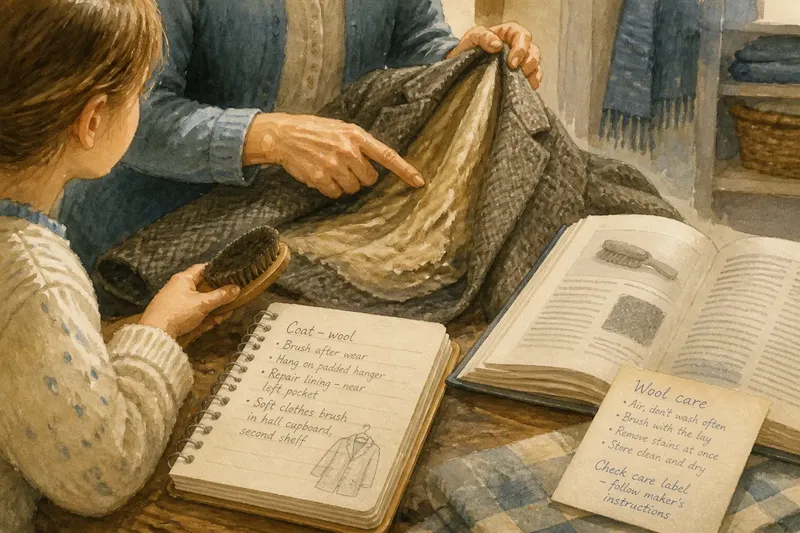
Imagine a household member has been asked to care for a wool coat that is not worn often. The starting point is a coat with a worn lining, a soft clothes brush stored in a hallway cupboard and no written care note. A relative points out the lining and demonstrates the household’s usual brushing method; the learner writes down where the brush is kept and which repair needs attention; then they consult a suitable printed reference for general wool-care terms. The result is a spoken demonstration for technique, a local note for the brush and repair, and a general source for background. The trade-off is that the reference cannot account for the coat’s condition, so the learner should follow the garment’s care label and seek qualified advice if uncertain about a consequential repair.
It is not worth copying an entire reference book into a household notebook or recording routines everyone can already perform comfortably. Preserve the detail another person may need when its usual holder is absent.
Choose a way to pass on household knowledge
Start by identifying what the learner needs to understand, then choose a form that can carry it. For each item below, check the stated observation and follow the decision that fits:
- Check whether the task depends on touch, timing or sound. If a learner needs to see or feel the process, arrange an oral demonstration; if the task is already familiar and only the sequence is easy to forget, write a short reminder instead.
- Check whether the instruction is specific to one home or object. If it concerns a particular recipe, garment or storage place, make a handwritten note naming it; if it applies broadly, consult a general reference instead.
- Check whether the learner knows the terms used in a reference. If not, explain them in conversation or add a plain-language note; if the terms are familiar, the printed reference may be enough.
- Check whether another person will use the record without its author. If so, add the object, circumstances and any exception; if only the author needs it, a shorter private reminder may suffice.
- Check whether a general instruction conflicts with a product label or manufacturer’s directions. If it does, follow the applicable product guidance and set aside the conflicting general advice; if there is no conflict, use the reference only where it suits the item.
- Check whether an error could have serious consequences. If it could, ask a suitably qualified professional rather than relying on inherited advice; if the task is routine and low-risk, use a demonstration or clear household note.
Questions about passing on household knowledge
How does oral teaching differ from a written household record?
Oral teaching combines speech, demonstration and questions, often while a task is under way. A written record remains available when the teacher is absent, but it needs enough context to make sense to someone else.
What can a printed household reference provide?
It can offer a broad account, shared terminology and a starting point for learning an unfamiliar task. It may not account for a particular home, tool or material, so local notes or direct instruction can still matter.
What household knowledge is useful to write down?
Record details that are easy to forget, specific to a home or likely to be needed by someone who has not seen the task. Name what the note concerns and say when the instruction applies.
Keep the context with the instruction
Household knowledge connects a person who knows, a person learning and a task that gives the advice its meaning. Conversation can make the lesson immediate; handwriting can carry local memory; print can provide a shared reference. None needs to do every job alone.
When passing on a useful instruction, leave room for the next person to ask why it is done that way and whether the circumstances have changed. A note or book can point towards an answer, while conversation can explain an exception. That context helps the learner decide when an old instruction still applies.